
Use the code to the left to get a discount on my products (and everyone else’s products) on TeachersPayTeachers, this week only!
Use the code to the left to get a discount on my products (and everyone else’s products) on TeachersPayTeachers, this week only!
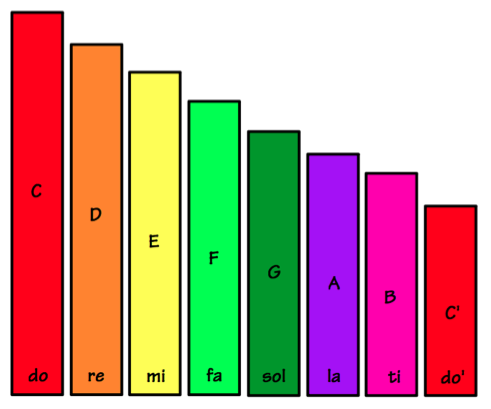 |
| Boomwhackers® |
Do you love using your Boomwhackers®
Download these flashcards, print in color, cut out (if desired), mount on construction paper individually or as a big poster, laminate, and instant pitch visual! Enjoy!
After a 11 week hiatus, I am back to blogging. On February 15, my family of three grew by 1 more as we welcomed our son, Graham, to the world. I have enjoyed the past 11 weeks being a mommy and spending time with our newest family member as well as my daughter and husband. I am grateful for my time at home and I will cherish that time forever.
 |
| Valentine’s Day Recorder Composition Project |
So last week I posted a composition lesson for Valentine’s Day. Last Friday was the beginning of my new rotation and I tried the lesson out on my 3rd and 4th grade recorder students. It was a big hit and a huge success! We read the poem, clapped the rhythms, composed pitches to go with the rhythm, and played it – and it was super fun, for me and them!
Record Your Class’ Compositions
I usually allow time to record our compositions and performances so I can post to my school’s website but we ran out of class time with both of my classes today. So I recorded their song for them so you could hear what a simple, sweet melody they came up with (with a little guidance from me!).
The quality of the recording is nothing to write home about and for that I apologize. But you get the idea of what a fun, beneficial project this can be!
Let Students Take a Copy of Their Composition Home
Students are always asking me to “print that out so I can take it home and share it with my mom.” With using ActivInspire software, I can export any flipchart page as a JPEG file. I know you can also do this PowerPoint as well as other SmartBoard and ActivBoard applications. In whatever platform you are working, export the file you wrote on with all the notes, print the file as a JPEG, but choose to print 4 images per page. The image gets smaller, but is still legible. This saves ink and paper, yet each student is able to take home a copy of their work. With Valentine’s Day, that is especially sweet, as your students can play their parents or their “Valentine” a musical Valentine 🙂
 |
| Valentine’s Day Composition – 4 Images Per Page |
If you want to download this project for either ActivInspire or PowerPoint, follow the links below…

Holidays are always fun to incorporate into material for music class lessons. Valentine’s Day is difficult though, being that there’s not a whole lot of Valentine’s music around – it’s not like we’re listening to a Valentine’s holiday station on the radio 😀

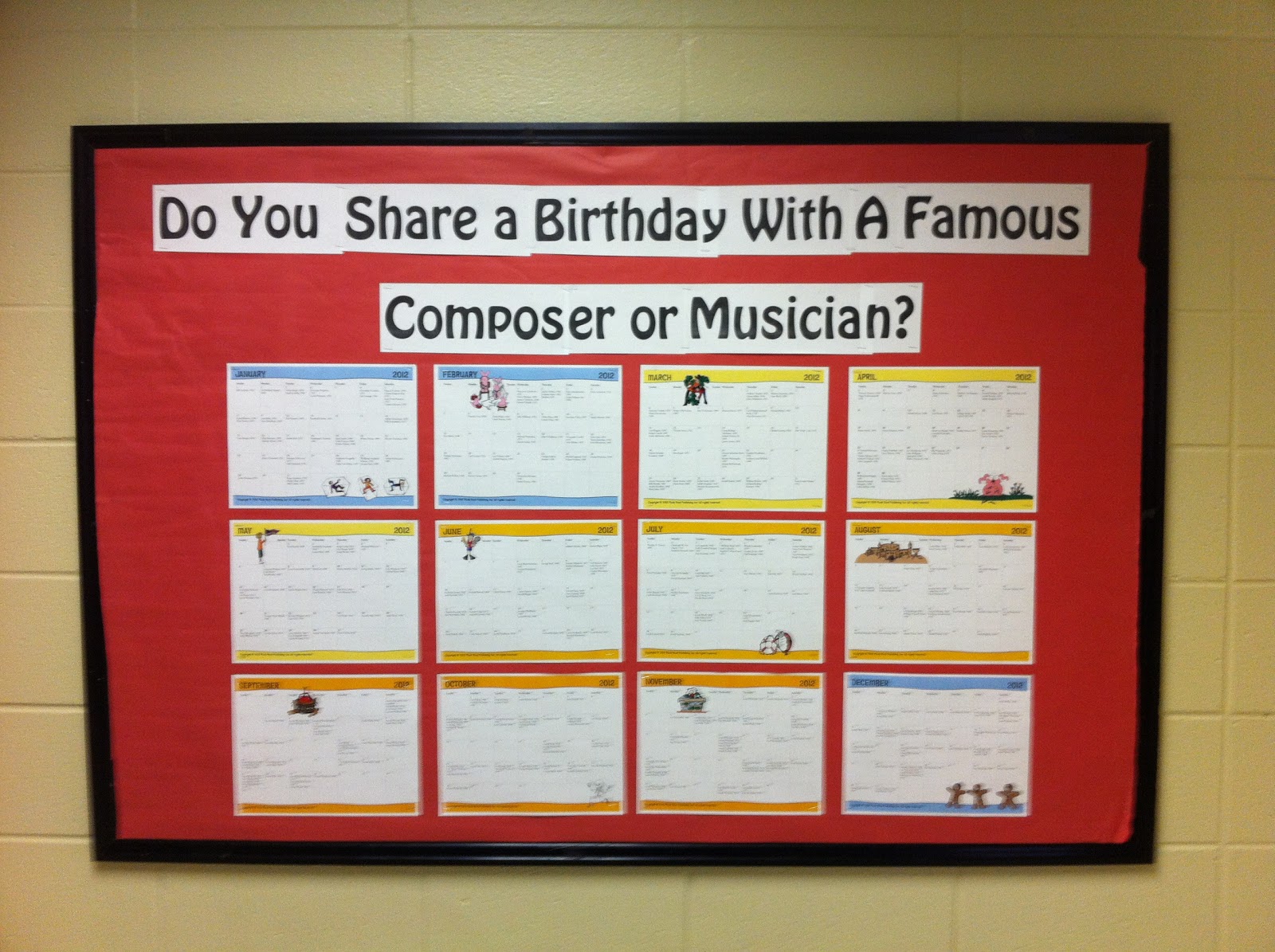
As my Friday Fave, I wanted to share a super easy, interesting, and non-seasonal bulletin board. I have this up right now on the small bulletin board in the hallway outside my room. It’s cute, simple, and took 5 minutes to put up! (If you can’t tell already, I am not a fan of bulletin boards….the easier and more-lasting they are, the better!)
To download the entire file to make the bulletin board and print all materials, click the link below…this is a freebie to you as my Friday thank you for reading and following my blog!
Happy Friday!
 Just a short reflection today….I am 9 months pregnant and have a head cold. I have ended up losing my voice and have only a whisper. What an awesome combination, right?
With no voice to use, I have written directions on the board today and have said very little. Especially in the older grades, I can write almost all the directions for the class period and they can and will read them and understand them. I have used my Flipchart software for the interactive whiteboard – at the end of every few sentences, I put some silly direction like “Touch your head when you are done reading this” or “Put your finger on your nose when you are ready to move on.” It has worked!
Fascinatingly, the kids have been practically silent too during these classes. If I have to whisper, they whisper back to me. Its hilarious!
It got me thinking…..do we teachers talk too much? Are there things that can go unsaid and be communicated other ways? Are we saying too little with too much?
Interesting thoughts…..what do you think?
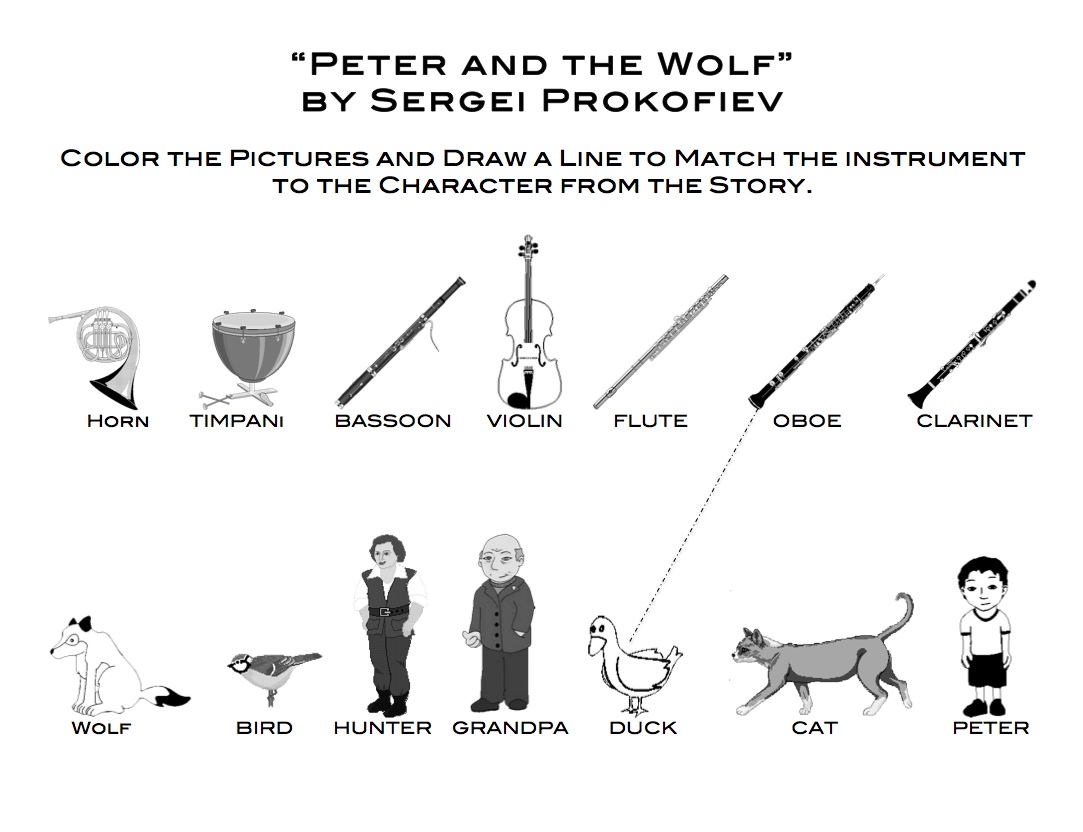 |
| “Peter and the Wolf” Instrument Coloring Page |
Last week I posted two entries about using centers to reinforce the instruments of the orchestra and using “Peter and the Wolf” as a vehicle for introducing the instruments and their sounds. If you haven’t read them, please check them out!!
Today, I started my Kindergarteners on a similar unit to my 1st and 2nd grade unit, except I changed their coloring page. This worksheet would work for many different uses – you could have your students complete it individually after watching the video or listening to the recording, complete it together as a class while listening or watching, or even complete it on the whiteboard as you watch.
Another benefit to these kinds of activities is the visibility of concepts and information students have been learning in music class. By allowing your students to take physical “evidence” of their music learning home with them, parents are getting to see what goes on in music. Our art is such an aural art that we sometimes miss opportunities to share our lessons with parents; worksheets and coloring pages are a great way to reinforce learning within your lesson as well as share the lesson with those at home!!
I will share more of these “evidence” activities in the future! Stay tuned!
Last week I posted about my love of using centers in the music classroom. My post included a complete centers unit, focused around the Orchestra Instrument Families, an important concept for all music learners. If you didn’t see my post, check it out HERE! You can also download the unit HERE!
When I introduce the instruments of the orchestra to my youngest students, my little Kindergarten friends, I like to start with something fun, to grab their attention. I cannot think of a better example of this than “Peter and the Wolf” by Sergei Prokofiev. He composed this piece as a way to teach young listeners about the instruments of the orchestra, and in my humble opinion, it accomplishes that very well! Prokofiev wrote the original story and narration, reflecting on his childhood experiences, as well as the music (obviously!). Over the years I have taught this piece in many different ways….here are some ideas and resources I have found that you should check out….
 – My school owns a copy of this on VHS that is now out-of-print and apparently extremely desirable, according to Amazon.com. New and used copies are going for like $15 to $100…really?!?! Crazy! This is what I use when I show it; however, after just a tiny bit of Googling, I realize the whole thing is on YouTube! Yay! Here is the link to the YouTube version, which is even better, since most of us don’t have VHS in our classrooms anymore anyway!

 winsomemusic.blog